Interview Secrets: The Questions Cruise Lines Always Ask (With Sample Answers)
I have bombed interviews.
Frozen mid-sentence. Rambled for four minutes in answer to a question that needed thirty seconds. Said things I immediately regretted and spent the rest of the day replaying on the train home.
I also know — from 13 years of coaching candidates and debriefing with hiring managers on what actually worked — exactly what was happening on the other side of that table while I was doing all of that.
Since then I have coached many people through their river cruise management interviews. I know which questions appear in almost every conversation. I know what a compelling answer looks like. And I know the specific difference between the candidate who gets the call the next morning and the one who receives the polite email three weeks later.
What follows is not a list of clever things to say. It is a framework for understanding what each question is actually asking — and what a genuine, compelling answer looks like.
The Question Behind Every Question
Before going through specifics, understand this: every interview question in river cruise management is really asking one of three things.
Can this person handle pressure without losing warmth?
Does this person understand what this role actually requires?
Would I want this person representing our brand with 180 guests watching?
Keep those three underlying questions in mind as you answer anything. They will tell you immediately whether your answer is on track — or drifting somewhere irrelevant.
Question 1: "Tell me about yourself."
WHAT THEY'RE REALLY ASKING:
Can you communicate clearly and get to the point? Do you understand what is relevant about your background for this role?
This is not small talk. It is your first impression of the entire conversation. Most candidates treat it as an invitation to summarise their CV in chronological order. That is a mistake.
❌ BAD: "Well, I was born in a small town and I always loved travel, and then I went to school, and then I worked at this hotel for three years, and then I moved to…" (four minutes later, still going)
✅ STRONG STRUCTURE: Past (brief background) → Present (what you do and do well) → Future (why river cruising, why this company, what you want to create for guests). Maximum 90 seconds. Connect your story to their needs — not the other way around.
✅ EXAMPLE:
"I'm a hospitality professional with eight years of experience, most recently as a restaurant manager at a four-star property. I've always been drawn to creating memorable guest experiences — it's why I got into this industry. River cruising combines everything I do best: building real relationships with guests over time, leading multicultural teams, and creating experiences that feel personal rather than scripted. I'm here because I want to do this at the highest level."
Question 2: "Why river cruising specifically?"
This is the most important question in the interview, and the one most candidates answer badly.
❌ BAD: "I love travel." / "The lifestyle appeals to me." / "I've always been interested in cruising." — These answers are about what you want for yourself. The question is really asking whether you understand what river cruising is about: the transformation you create for guests, not the lifestyle you would enjoy for yourself.
❌ ALSO BAD: "The salary is better than my current job." (Signals you will leave for higher pay the moment someone offers it.)
✅ STRONG:
"River cruising offers something I cannot replicate in a hotel: the ability to build a real relationship with a guest over 7 or 14 days. In a hotel, I see guests at check-in and check-out. On a river cruise, I understand their preferences by day two, anticipate their needs by day four, and by the final night I am part of a memory they will carry for years. That depth of connection is what I am here for."
Question 3: "Describe your most difficult guest situation and how you handled it."
WHAT THEY'RE REALLY ASKING:
Do you take ownership? Does experience translate into growth? Can you tell a story where the guest was right even when the situation was difficult?
They want ownership, a clear resolution, and — most importantly — what you learned. The learning is the evidence that experience became growth.
❌ BAD: "I always stay calm and professional." (Anyone can say this. It proves nothing.)
Use the STAR method: Situation → Task → Action → Result
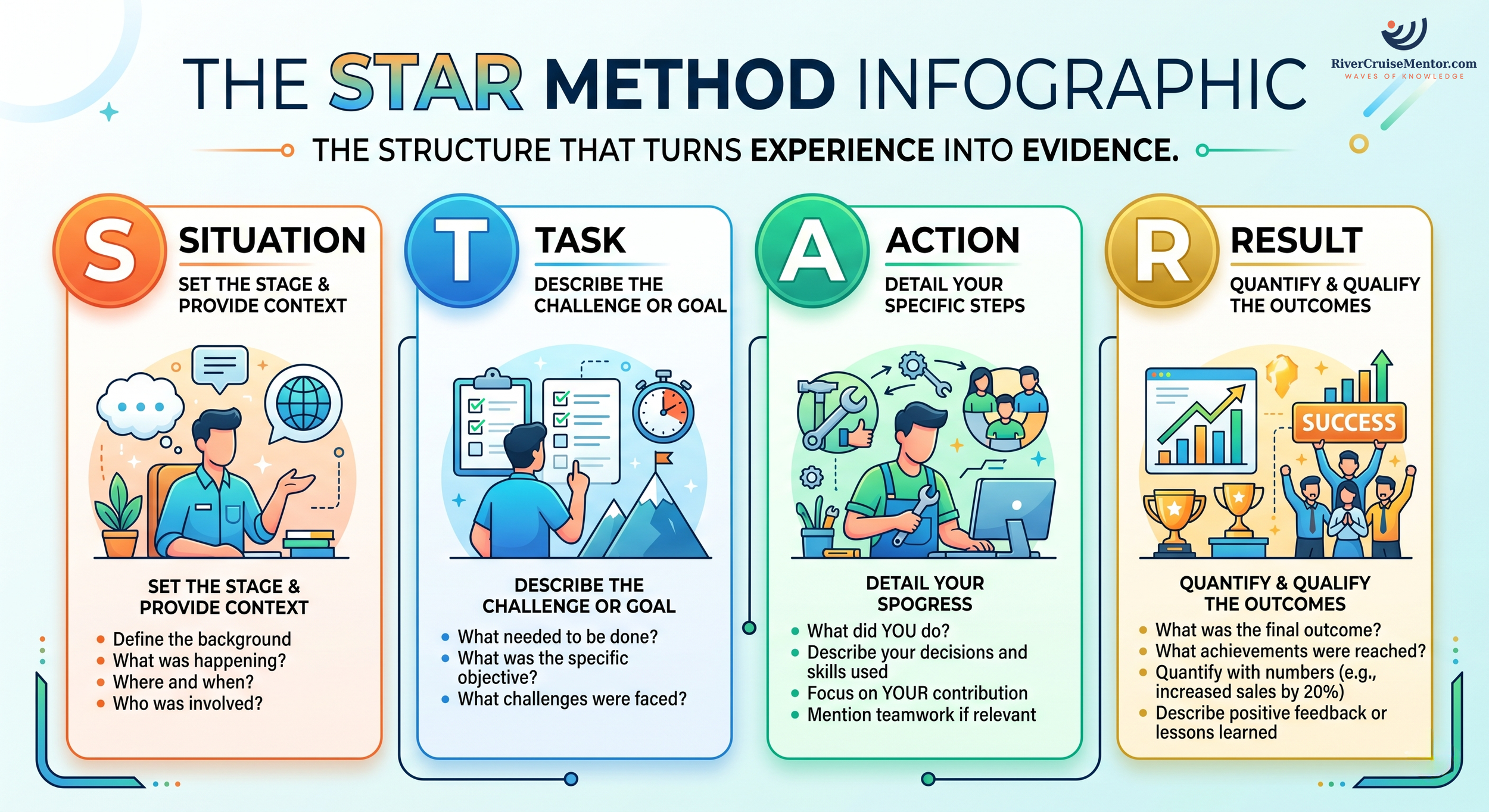
✅ STRONG EXAMPLE (STAR):
Situation: Last summer, a guest discovered her room was not ready three hours after check-in. She was celebrating her anniversary and was visibly upset.
Task: Recover the situation and turn her experience around.
Action: I acknowledged her frustration without excuses, upgraded her to our best available room, arranged champagne with a handwritten note, and personally escorted her. I followed up that evening.
Result: She left a five-star review specifically mentioning how I transformed a disaster into the highlight of her trip. She has returned twice since.
Notice: the system failed, not the guest. You took ownership. That is the story structure they are looking for every time.
Question 4: "What would you do if an excursion was cancelled last minute?"
WHAT THEY'RE REALLY ASKING:
Can you stay calm under genuine pressure and lead guests through disappointment without losing their trust?
❌ BAD: "I would apologise and explain that unfortunately it was outside our control." (Explanation before empathy. Guests feel processed, not heard.)
✅ STRONG: "First, 60 seconds to process — panic never helps anyone. Then I identify alternatives immediately: what is nearby, what local contacts do I have, what can we do on the ship? I communicate honestly and present the alternative with enthusiasm, not apology. Guests take their cues from the Cruise Manager — if I am genuinely excited about Plan B, they will be too."
I once had a castle close unexpectedly the morning of our visit. Within two hours we had arranged an exclusive private wine tasting at a family vineyard that does not normally receive tour groups. Guests called it the best afternoon of the entire cruise. The closure was a gift they didn't know they were getting.
Question 5: "How would you handle a guest who is unhappy about something outside your control?"
WHAT THEY'RE REALLY ASKING:
Do you default to explanation — or to the person in front of you?
Weather delays. Closed museums. Mechanical issues. These happen on every season. The question is not whether you can prevent them. It is whether you understand what the guest needs in that moment.
The correct order is always: Empathy first. Explanation second. Solution always.
❌ WRONG ORDER: "Unfortunately the museum had to close due to a private event, which was completely outside our control, but I understand this is frustrating." (Explanation before connection. Guest feels processed.)
✅ RIGHT ORDER: "I understand how disappointing this is — you have been looking forward to this visit. Let me tell you what I have arranged instead." (Connection first. Plan second. Guest feels seen before they feel managed.)
Question 6: "How would you handle a crew conflict?"
WHAT THEY'RE REALLY ASKING:
Can you lead people, not just guests? Do you understand that unresolved crew tension always reaches the guests eventually?
"I address conflicts early, before they escalate. I speak with each person privately first — people often have valid concerns that get lost in the emotion. Then I bring them together, focus on shared goals rather than past grievances, and establish clear expectations. The key is making both parties feel heard while keeping the team functional. Crew tension always surfaces in the guest experience eventually."
Preparing for your first contract and want to practise these answers in a structured mock interview before the real one? This is one of the core components of Academy preparation: rivercruisementor.com
✅ STRONG:
"I address conflicts early, before they escalate. I speak with each person privately first — people often have valid concerns that get lost in the emotion. Then I bring them together, focus on shared goals rather than past grievances, and establish clear expectations. The key is making both parties feel heard while keeping the team functional. Crew tension always surfaces in the guest experience eventually."
Preparing for your first contract and want to practise these answers in a structured mock interview before the real one? This is one of the core components of Academy preparation: rivercruisementor.com
Question 7: "What languages do you speak?"
WHAT THEY'RE REALLY ASKING:
Are you honest about your actual level — and do you show the right orientation toward development?
This question intimidates many candidates. It shouldn't. English is essential. Everything else is additive. Be honest and frame additional languages as ongoing development, not fixed limitations.
❌ BAD: "I speak a little German." (Vague and self-diminishing.)
✅ STRONG: "My German is conversational and actively improving — I am working on it consistently. My English is professional level." (Honest. Shows growth orientation, not apology.)
Question 8: "What are your salary expectations?"
WHAT THEY'RE REALLY ASKING:
Are you realistic about the industry? Do you understand how river cruise compensation actually works?
This question trips up candidates from traditional hospitality backgrounds more than almost any other — because the compensation model is genuinely different and many candidates have not done their homework.
River cruise management is typically compensated by daily rate across a seasonal contract — not an annual salary. A professional River Cruise Manager working a standard European season earns in the range of €45,000–75,000 for approximately 120 working days. That context matters enormously when you answer this question.
❌ BAD: "I'm currently earning €2,200 per month, so I would need at least that." (Shows you have not researched the industry. Anchors the conversation to your current situation, not the market.)
❌ ALSO BAD: "I'm flexible, whatever you think is fair." (Shows no understanding of your own professional value.)
✅ STRONG:
"I understand river cruise compensation works differently from hotel roles — based on daily rate across a seasonal contract rather than annual salary. My research suggests the range for this level of position is in line with what I am targeting. I am more focused at this stage on the right first contract and the right company than on negotiating the maximum rate on day one."
⛏ PRO TIP: Never anchor to your current salary in a river cruise interview.
Your current salary reflects a 260-day-a-year hospitality role. River cruise compensation reflects a 120-day-a-year specialist role. They are not comparable — and framing them as comparable immediately signals you have not done your research.
If pressed for a specific number before you have enough information: "I would want to understand the full package — contract length, daily rate, and the development pathway — before giving you a number that would be meaningful for both of us."
Question 9: "Where do you see yourself in three to five years?"
WHAT THEY'RE REALLY ASKING:
Is this a genuine career commitment or a curiosity experiment? Will you still be here in two seasons?
Training someone for this role is a significant investment. They are checking for longevity and real ambition — not the ambition to take their job, but the ambition to grow into genuine excellence.
❌ BAD: "Doing this job." (No ambition.) / "In your job." (Threatening ambition.)
✅ STRONG: "In five years I see myself as a senior River Cruise Manager, possibly contributing to training or taking on fleet-level responsibilities. I want to master this role first — the nuances of different rivers, seasons, and guest demographics. Then I want to contribute to developing the next generation. This industry is giving me an opportunity. I want to eventually pay that forward."
The Question That Closes the Interview: "Do You Have Any Questions for Us?"
Yes. Always. These are the questions that signal genuine intelligence and professional ambition:
"What does success look like in the first ninety days?"
"What do your best Cruise Managers have in common?"
"What is the biggest challenge facing your Cruise Managers right now?"
"How does the relationship between the Cruise Manager and Hotel Manager typically work on your ships?"
Never ask about salary in a first interview. Never arrive without questions.
That last section — your questions for them — is a quiet power shift. It moves the conversation from "please hire me" to "I am also evaluating whether your brand matches my standards." That confidence, when it is earned and not performed, is exactly what hiring managers remember.
REMEMBER:
The Framework That Works Across Every Answer: STAR
For any question that asks you to describe a situation, a challenge, or a decision — use this structure consistently:
SITUATION: Brief context (one to two sentences maximum)
TASK: What was your specific responsibility in that moment?
ACTION: What did YOU do specifically? Not the team — you.
RESULT: What happened as a direct outcome? Quantify where possible.
The Preparation That Changes the Outcome
Mock interviews matter. Not because they make you sound more polished — but because they make you less afraid.
When you have answered these questions out loud fifteen times to a coach who gives you honest, specific feedback, you walk into the real interview with a calm you genuinely cannot fake any other way. The nervousness does not disappear. It stops running the conversation.
Drop your biggest interview anxiety in the comments. I read every one and answer the ones that come up most often in future posts.
Ready to walk into that interview prepared?
Book a free 20-min 1-1 call with me directly

Maddy Căldărușe
Founder, RiverCruiseMentor.com